Homesharing – Part 2

Homesharing has been a “thing” for years and its use is growing along with internet applications that facilitate transactions involving making a residence available for short-term rentals. Standard homeowner policies have long been issued under the assumption that a covered residence is usually occupied by the named insured and that person’s family on a full-time basis.

While insurance policies issued for homes, condos, and apartments do contemplate some situations involving other persons staying in a residence, those situations are allowable when they don’t involve financial transactions. Renting for income alters a residential situation into a business. Business activity creates a coverage problem which could result in policies being canceled or claims being denied. Renting all our part of a residence also results in types of losses that are uncovered because they haven’t been contemplated as insurable, residential activities.

Policy wording may exclude coverage for losses when they are directly related to a business. So, protection may be lost for the residence, residential property as well as for liability for damage or injury to others and their property.

Basic HO policies, if they don’t outright exclude losses involve compensated rentals, severely restrict other coverage. However, due to the rising popularity of homesharing, the insurance market is responding with options to provide more protection. A basic policy may be amended to extend protection which does the following:

  • Extend eligibility of a rented residence to continue to qualify for all policy protection
  • Add protection for household contents that might be damaged or destroyed during rentals
  • Extend medical payments coverage to insureds who may be injured by renters
  • Loss of income specific to homesharing activity
  • Add liability coverage for injury to third parties that occur during rentals

However, this additional protection may still fall short of what is needed. The insurance market is now making broader coverage available that handles less common exposures such as ID theft resulting from homesharing, pest infestation caused by renters, liquor liability coverage arising from alcohol served during rentals, extra cost caused by excessive use of utilities, or personal and advertising liability.

Even with special coverage for homesharing, property owners should also be aware of consequences and cost of resolving issues such as breaking local zoning laws, violating residential association bylaws or legal costs of dealing with squatting situations. Homesharing is a popular component of the sharing economy, but participants need to be careful to get proper protection.


           Return to Part 1


COPYRIGHT: Insurance Publishing Plus, Inc. 2018

All rights reserved. Production or distribution, whether in whole or in part, in any form of media or language; and no matter what country, state or territory, is expressly forbidden without written consent of Insurance Publishing Plus, Inc.

Homesharing – Part 1

For a variety of reasons, changing attitudes, objectives and financial situations have created interest in collaborative consumption and the growth in the sharing economy. Homesharing and ridesharing have become major components in this evolving economy. The term can be confusing and have more than one meaning.

Regarding this article, we are discussing commercial arrangements represented by services such as AirBnB. Its premise is to match supply and demand for housing related to traveling. It allows a resident of a home, condo or apartment in one location to provide short-term housing to persons traveling through or vacationing in their locale. The arrangement is facilitated through an online platform that provides the obligations of both parties to the transaction. Therefore, this discussion does not involve situations involving short-term trading or swapping of property in exchange for either similar residential space or in exchange for providing skills or services.

A wide variety of rental situations fall under homesharing, such as the following:

  • Rental of seasonally used property
  • Rental of entire premises for vacationers
  • Rental or part or entire premises for persons attending a local, large event such as racing, festivals, concerts, tournaments, sports championships, etc.
  • Providing space for a special event, such as graduations, weddings, or parties (birthday, retirement, etc.)
  • Renting a portion of a residence while the property owner or regular renter still occupies other parts of the residence

The online aspect is critical as it acts as a portal for providing information on available residences, locations of property, property features, rental costs, available amenities, contractual obligations related to property use and payment of fees, deposits, and, if necessary, damages or penalties due to misuse.

A major motivation for such homesharing arrangements is the opportunity of significant, additional income for underutilized property. However, that creates a problem. What coverage issues exist under residential insurance policies?


Continue to Part 2


COPYRIGHT: Insurance Publishing Plus, Inc. 2018

All rights reserved. Production or distribution, whether in whole or in part, in any form of media or language; and no matter what country, state or territory, is expressly forbidden without written consent of Insurance Publishing Plus, Inc.

Understanding your home insurance deductibles

Deductibles with Truepoint Insurance

For many years, deductibles have been considered to be a fundamental element of the insurance contract. It is therefore vital to understand its importance when insuring your Fisherville, KY home to reap the benefit of your insurance policy.

A deductible is an amount of money the insurance holder pays towards an insured loss. Therefore, a financial obligation by the insurance holder since it forms part of the insurance contract. On many occasions, the amount you come up with as the deductible is paid before a claim.

Insurance deductibles have basics as explained below:

How to identify the amount of your deductible

On your contract, the insurance deductible is listed under the terms and conditions section which is on the declaration page of the insurance policy. As a homeowner, you will choose the deductible amount for your home and the contents. The policyholder chooses how much the deductible will be, but the insurance company sets the minimum deductible depending on the insurance policy, but regardless, the higher the deductible, the lower the cost of insurance.

How to save money with a deductible

As an insurance holder, despite the fact that you pay the premiums, you might not have claims every year. It is, for this reason, an advantage especially in instances where you pay higher deductibles or an increased amount of deductible more than the minimum since you will be able to save a good percentage on your insurance cost.

How to identify a loyalty deductible

It is important to understand the costs for each deductible on each policy. In case a policy has a waiver, and its cost is the same as policy without a waiver, then consider it as a loyalty advantage and a pleasant characteristic of the coverage you are purchasing. If there is a cost attached, then as the policyholder, it is upon you to contemplate whether it is worthwhile to pay more.

Being one of the fastest growing insurance companies in Fisherville, KY, Truepoint Insurance offers help with home insurance policies. Contact our offices to speak with an agent and to have your questions answered. We look forward to hearing from you.

Do I Need Flood Insurance?

flood insurance, KY flood insurance. buy flood insurance, FEMA national flood insurance programs. do i need flood insruance Flood insurance isn’t usually a standard part of a homeowners or renters insurance policy. While not everyone needs to buy a separate FEMA flood insurance policy; however, the worst thing you can do is wait for a rainy day before you find out if you need it. 

TruePoint Insurance provides flood insurance to many in Central Kentucky.  Covering much of the area between Louisville and Lexington.  Some people are more prone to a flood than others and only some must have it. 

We’ve heard many times in the past, “I don’t need flood insurance, I already have a homeowner’s insurance policy.   Our response is always the same! 

At other times we have been asked, “Does my homeowner’s policy provide flood insurance?”  homer's insurance doesn't cover flood, flood insurance is a separate policy, call 502-410-5089 to learn about the National Food Insurance Program

We quickly respond, “No!”

“How can you tell without looking at my policy?”

“Because flood insurance requires a separate policy.”  “Always!”

1. High-Risk Areas

If you live in a high-risk area for flooding, you want to purchase a flood

learn how the FEMA National Flood Insurance Program can help me
FEMA National Flood Insurance Program

insurance policy to protect your assets. You also want to if you’re at moderate risk for flooding. It’s important to discuss your risk with the insurance company, so you can determine exactly what risk you have for flooding. 

2. Could be Required

Those who live in an area at a high risk for flooding may be required by the lender to have flood insurance. You should contact your lender to determine what type of coverage you need in addition to a standard homeowners insurance policy. Keep in mind, you could experience legal troubles in addition to financial ones if you’re caught without flood insurance.

3. Flooding in the Past

Flood Zone, Flood Zone C, Flood Zone A, Flood Zone X, Flood Insurance. Kentucky Flood insuranceEven if you don’t live in an area prone to floods, if you’ve had flooding in the past, you don’t want to take any chances. It’s beneficial to have flood insurance just in case it should happen again in the future. 
4. Whether You Rent or Own

It doesn’t matter whether you rent or own. You can obtain flood insurance, no matter what. The coverage is a bit different when you rent, so make sure you read the details of your policy to ensure you have all the coverage you need in the event of a flood. 

                            Learn more about FEMA’s                                  National Flood Insurance Program

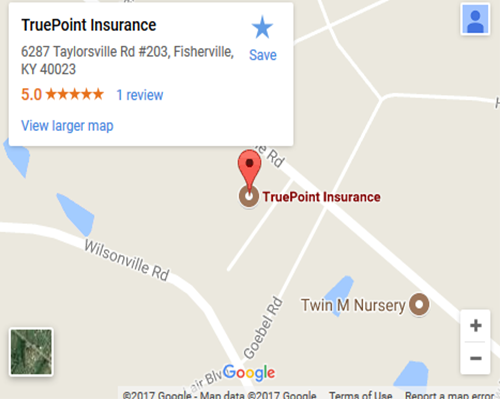
To get a quote for flood insurance from TruePoint Insurance, call or visit either of our Kentucky offices: 1085 Eagle Lake Drive in Lawrenceburg or 6287 Taylorsville Rd in Fisherville. Or call (502) 410-5089.

Take control of your insurance

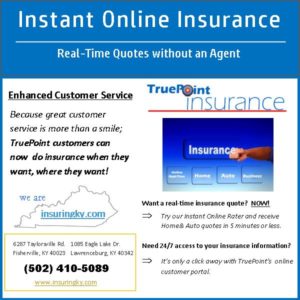
Instant online insurance quotes in real-time from a real insurance agency

Family Feud-The Insurance Addition:

100 people surveyed

Reasons people overpay for Home & Auto Insurance:

The #1 Answer:  I Don’t Know

The #2 Answer: Unwilling to talk to an Insurance Agents

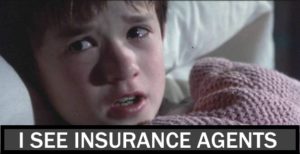
Afraid of insurance agents?
Taking control of your insurance starts with finding an agent that you can trust


Maybe it’s time to experience TruePoint’s Customer Service.  Visit our site at www.insuringky.com for an instant online home, auto or home & auto package quote.  Instant insurance quotes in real-time, 24/7 without an agent.

Our customer focused approach puts you in the drivers seat.  In addition to instant online quotes, our clients have online access to all of their important personal insurance documents.  Stop worrying about getting pulled over by police with an expired certificate of insurance.  As long as you have a cell phone you can deliver acceptable proof of insurance any time night or day.  Maybe you have water standing in your basement.  You want to check your insurance policy but it has been ruined by the water.  Don’t go all weekend worrying if you have water backup coverage, visit the TruePoint Customer Portal to access the information that you need.  TruePoint provides full service insurance and risk management assistance to individuals and businesses in Kentkucky, Southern Indiana, the South Carolina Low Country and Coastal Georgia.


 Residents in Kentucky and Indiana should call:      (502) 410-5089
Residnets in Georgia or South Carolina shouild call:     (912) 330-1265
or visit our website at www.insuringky.com

or visit our website at www.insuringky.com